Prompt:
Below you will find five images. For this paper I would like to choose one and write a thesis-driven essay in which you analyze the central point of the image based on ideas we’ve been discussing from John Berger’s Ways of Seeing.
In order to do this you should focus on how the image is composed–how it is put together– in order to produce this central point. What strategies does the artist or photographer employ to create this point? How is the subject of the image positioned? What sorts of colors are used? Does the image imply movement or stasis and what effect does this create? How does he or she comment on or use the traditions from European art that Berger has identified? How does he or she depart from these traditions?
As you think about these questions, you should consider the image from the perspective of one of Berger’s primary lenses from an episode of Ways of Seeing. For instance, if you are interested in ideas from episode 2, you might consider how the strategies employed by the artist comments on issues related to gender and/or sexuality. Or, if you’e interested in how the image you’ve chosen combines different European and non-European traditions to produce something new, you could look to the ideas Berger describes in episode 1.
[If you need a quick reminder of what each episode is about you might look to the Wikipedia entry for Ways of Seeing. You might also look at what you’ve written about in your responses to discussion questions and the course blog or watch the episode you’re interested in again.]
The above questions are meant to guide you, and as you work on the paper you may find yourself addressing one or more of these or even asking your own. The key to this paper is writing a focused analysis of how you see the image as conveying what you see as its central point.
Format:
- 1000 words
- Typed
- Double-spaced
- 12-point, Times New Roman font
Due Date:
- 10/24-uploaded to Blackboard before the start of class
Images:
This image is of Ieshia Evans, a demonstrator at an event that followed the shooting of Alton Sterling by a policeman in Baton Rouge, LA, being arrested. It became a widely circulated image within the Black Lives Matter Movement as well as other social justice movements, and became resonant for those who deal with the intersections of race and criminal justice. The photographer went on to win several awards and was a finalist for the prestigious Pulitzer Prize for “Breaking News Photography.”

Creator:© Jonathan Bachman / Reuters Credit:REUTERS
This is a painting by the artist Kehinde Wiley. Wiley is known for riffing on European artistic tropes to produce portraits of people of color. (As a side note, Wiley just unveiled a statute very similar to this painting in Times Square. It will be in NYC for two months before it goes to Richmond, VA, where it will be on permanent display.)
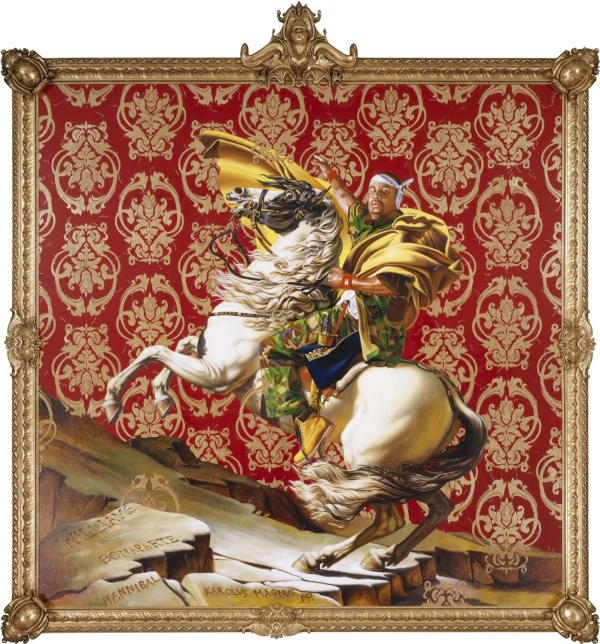
Kehinde Wiley (American, b. 1977) “Napoleon Leading the Army over the Alps,” 2005. Oil on canvas, 108 X 108 in. Collection of Suzi and Andrew B. Cohen. copyright: Kehinde Wiley (Photo: Sarah DiSantis, Brooklyn Museum.)
This painting, titled “The Forgotten Man,” is by Utah-based artist Jon McNaughton, a vehement critic of the Obama administration and an ardent supporter of President Trump. This painting became associated with the Trump Administration after his inaugural speech.
https://cdn10.bigcommerce.com/s-dcvfa4/products/1635/images/2646/JM102_The-Forgotten-Man—__08735.1460475182.1280.1280.jpg?c=2
Jon McNaughton, “The Forgotten Man,” n.d.
This is a photograph taken by Thomas Hoepker that seems to show a group of people relaxing while the World Trade Center towers fall on September 11, 2001. (click on the image for a clearer view.)

Thomas Hoepker. USA. Brooklyn, New York. September 11, 2001. Young people relax during their lunch break along the East River while a huge plume of smoke rises from Lower Manhattan after the attack on the World Trade Center.
This is a photograph of Donna Gottschalk, a photographer who has been active in the LGBTQ rights movements since the 1970s. This picture was taken by Diana Davies at the 1970 Christopher Street Gay Liberation Parade.
No Description

 Berger discusses oil painting in episode 3 ways of seeing , in which he says buying painting also buys the looks of painting. From ancient time value of painting are mysterious ,they placed at different places which becomes popular and unique . Because of popularity of paintings art gallery looks like palace and needs to be cautions. This particular image was painted in 1533 by Holbein Shows two french diplomat in London .This picture illustrate wealth of these two men in which one man dressed up well in huge fur coat ,his jewelers , where as other man he has different look but they both appeared wealthy in this painting , but every culture is uniquely complex and it shows to make a statement on other cultures in opposition . However Berger demonstrate in episode 2 is same as this painting , in which how wealthy it shows through embroiderers , furies , jewelers , carpet work and leathers . if we viewed in different it has another way of meaning . where i can say they are preparing for a war in which they appears in unique look . There culture are advancement to the rest of the world.
 This is Supreme ad illustrates wealth in today’s society, particularly in New York City. this brand name is incredibly expensive, and the same sort of items, that are similar looking and are for the same purpose are available on the market for a fraction of the cost of this stupid chest-fanny pack looking thing. This is similar in a lot of ways to the European oil paintings shown in the third episode of “Ways of Seeing”. In this episode, we see many of the rich citizens depicted are wearing extravagant clothes and jewelry that only the wealthiest would be able to afford, as seen in this ad. There is also a certain emotion coming from the model that can be related to the attitude eluded from the paintings. this model is not looking directly at the lease, and is in a relaxed position, almost as if to say, “yeah I’m wearing supreme and I don’t even care, I have money to burn.” Although the men and particularly women in the wealth inspired painting are much more uptight as this Supreme model, the attitude is still the same. these paintings scream, “I’m so dang rich, I’m surrounded by stuff that I don’t even use on a regularly basis and they are worth more than your entire estate.” not to mention, none of these people actually NEED such expensive things….no one.